
Equipment
Both machine types, and our own power
Laser cleaning is not one tool. Pulsed and continuous wave machines behave differently enough that the choice between them decides whether a job goes well. We run both, which means the machine is picked to fit the work rather than the work being talked into fitting the machine.
We also arrive with our own power and air, so nothing needs to be arranged on your side before we start.
The right beam for the job
Most providers own one machine and have to compromise. A pulsed-only shop is slow on heavy structural work; a continuous-only shop risks heat damage on thin or delicate substrates. Owning both removes that compromise.
Precision and delicate work
- Thin coatings and selective layer removal
- Heat-sensitive substrates and thin sheet
- Aluminum and non-ferrous metals
- Precision mold and tooling work
- Light rust, oxidation, and surface films
- Electronics, detailed castings, and restoration work
Bulk removal and production throughput
- Heavy and thick coatings
- Large-area rust and mill scale
- Structural steel and weldments
- Heavy equipment and agricultural implements
- Production volume where cycle time drives cost
- Work where surface heat input is not a concern
We bring our own power
The rig runs off its own generator, so we do not need to tie into your electrical supply at all. On a working plant that matters more than it sounds — tapping a panel can mean scheduling an electrician, pulling a permit, or taking a circuit down.
If you would rather we used your 220V supply, we can. Point us at an outlet during the assessment and we will plan around it. It is an option, never a requirement.
The compressor travels with us for the same reason. Between the two, the only thing we need from your site is access and clear space around the work.
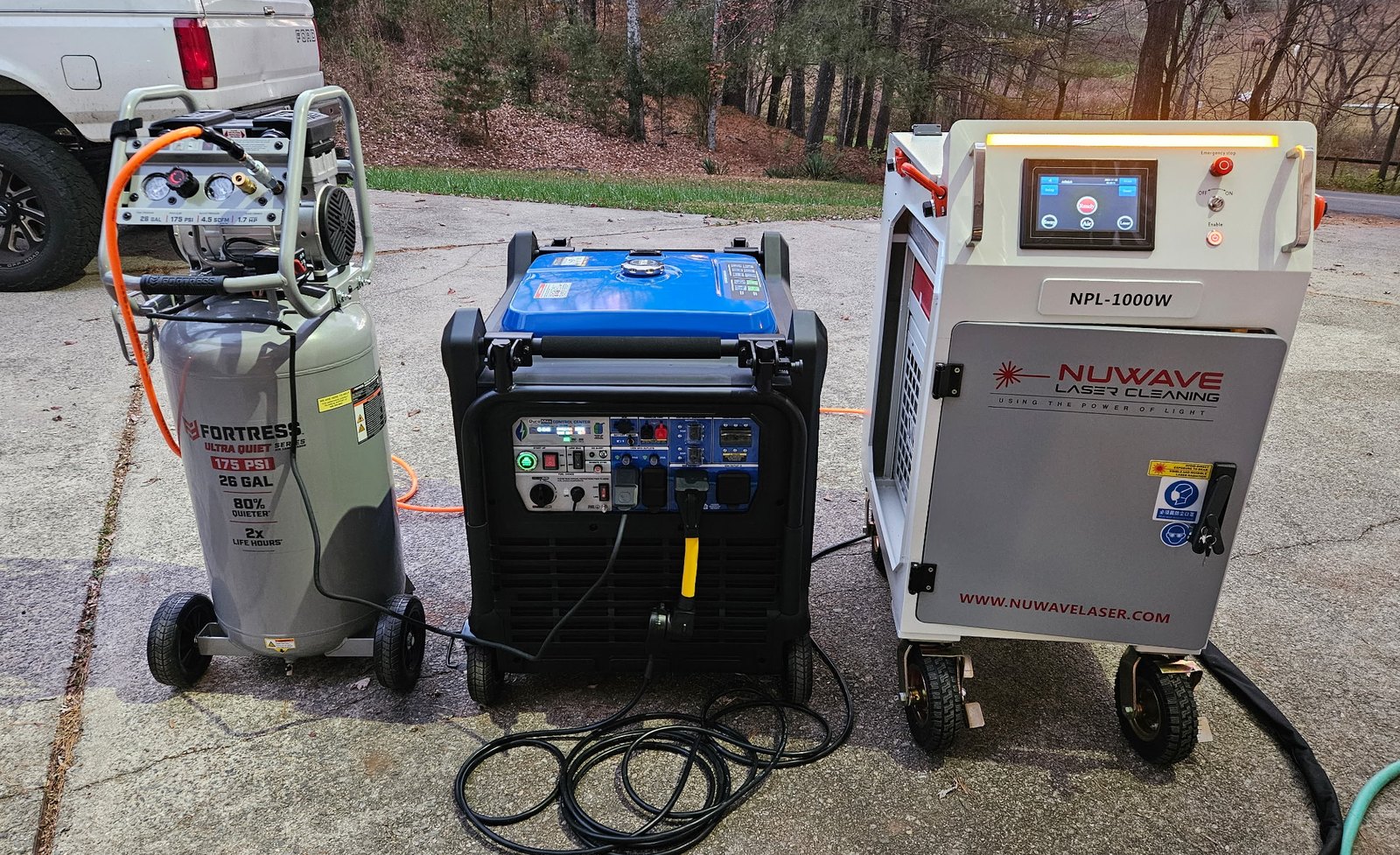
Dual fuel
Runs on propane or gasoline. Propane matters on sites that restrict gasoline storage — we can arrive set up for whichever your facility allows.
240V capable
Powers either machine without tying into your supply, so there is no electrician, no permit, and no shutdown to arrange before we start.
Clean inverter power
Under 3% total harmonic distortion. The laser's control electronics are sensitive, and dirty power is a real risk to them on a jobsite.
GFCI outlets built in
Ground-fault protection comes from the generator itself rather than depending on whatever the nearest outlet happens to offer.
Automatic CO shutdown
The unit shuts itself down if carbon monoxide builds up. Exhaust is still sited away from doors, windows, air intakes, and occupied space on every job.
All-day runtime
A full working shift on one fill at typical load, so refuelling happens between jobs rather than partway through yours.
What we can work on
The honest answer always depends on the substrate’s condition and what is sitting on it, which is why a test patch comes first on every job. Here is where each material generally stands.
| Substrate | Typically removed | Notes |
|---|---|---|
| Carbon steel and cast iron | Rust, mill scale, paint, weld spatter, grease | The most forgiving substrate. Continuous wave handles large areas and heavy build-up quickly. |
| Stainless steel | Heat tint, biofilm, carbon build-up, ink, coatings | Cleans well without abrasion, so the passive layer and finish are preserved rather than ground away. |
| Aluminum and non-ferrous | Oxidation, coatings, adhesive, anodizing | Pulsed wave, lower energy. Reflective and heat-sensitive, so parameters are set conservatively and proven on a patch first. |
| Tool steel and mold tooling | Release agents, resin, flash, carbon, corrosion | Non-contact means critical dimensions, polish, and texture survive cleaning — the usual reason shops move away from abrasives here. |
| Stone, brick, and concrete | Graffiti, soot, paint, biological growth, staining | Viable and commonly done, but porous and mineral-variable. Always test-patched in an inconspicuous area. |
| Wood | Paint, varnish, soot, surface char | Possible with careful parameters on sound timber. Highly grain- and species-dependent; treated case by case. |
| Plastics and composites | Mold release, adhesive, ink, surface films | Case by case. Many polymers absorb strongly and can be damaged, so this is always assessed before quoting. |
| Electronics and precision assemblies | Flux, solder residue, oxidation, contamination | Pulsed wave at low energy, tightly targeted. Non-contact and dry, with no solvent bath and nothing to work into a crevice. |
Regulated coatings are the exception: lead, cadmium, and chromate primers are abatement work with their own requirements, and we screen for them before quoting rather than taking them on. More on that in the FAQ.