
Why laser
Why the substrate survives
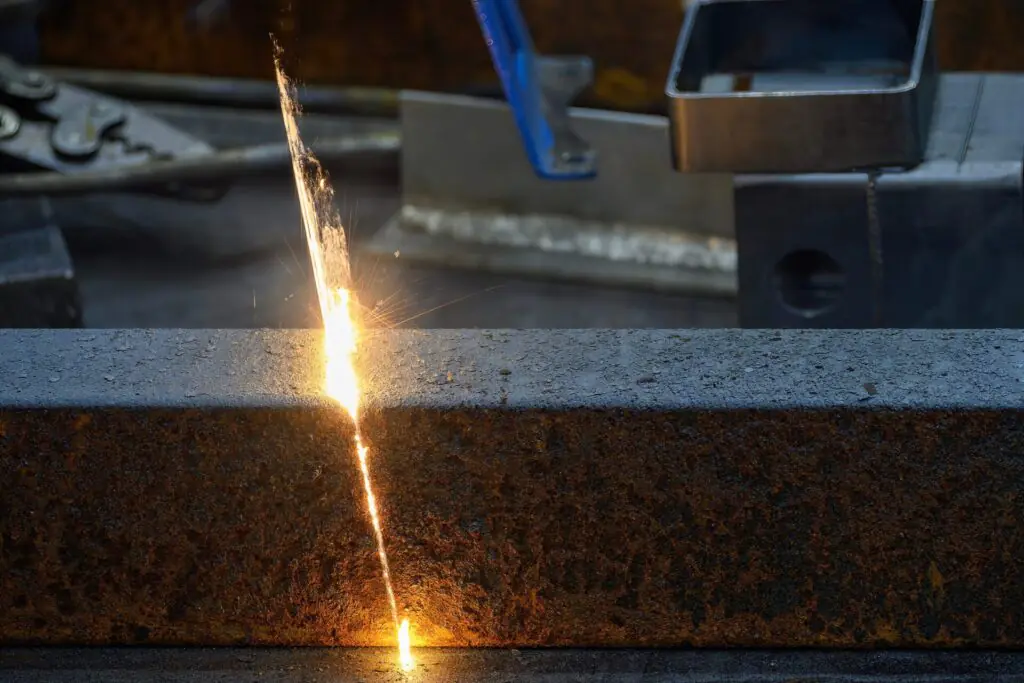
Every material has an ablation threshold — the energy level at which it begins to vaporize. Rust, paint, oil, and coatings have far lower thresholds than steel, stainless, or aluminum.
Set the beam above the contaminant’s threshold and below the substrate’s, and the unwanted layer leaves while the base metal stays essentially untouched. That physical gap is what makes the process selective — and it is something a blast nozzle cannot do, because grit has no way to tell a coating from the metal beneath it.
It is also why every job starts with a test patch. Coating, substrate, and condition all shift where that window sits, so we prove the parameters on your actual part, show you the result, and only then work at scale.
What that gets you in practice
The physics is only interesting because of what follows from it — no media to buy or dispose of, no dimensional loss on the part, and usually no teardown.
Selective by physics
Contaminants absorb laser energy at a far lower threshold than the metal beneath them, so the unwanted layer leaves and the substrate stays.
No contact, no abrasion
Nothing touches the part. Dimensions, polish, texture, and wall thickness are preserved instead of being worn away.
No chemicals
No solvents, no strippers, no neutralizing rinse, and no liquid hazardous waste to store or dispose of.
No blast media
Nothing to buy by the drum, nothing to sweep out of a machine bed, and no spent grit to characterize and haul away.
Less downtime
Frequently done in place with minimal masking or teardown, and the surface is dry and ready for the next process immediately.
Field ready
The equipment travels, and it brings its own power. Statewide mobile service on our own generator means large or fixed assets are cleaned where they sit, without tying into your supply.
Low dust
Removed material is captured with extraction at the source rather than becoming airborne across a work area.
Documented and repeatable
Parameters proven on a test patch are recorded, so the same result can be reproduced on the next batch or the next visit.
How it compares
Laser cleaning often looks more expensive per square foot than blasting — until the rest of the job is counted.
Grit has to be bought, swept out of machine beds, characterized, and hauled away. Chemical strippers need ventilation, spill control, and disposal. Both usually mean masking, containment, and taking the asset out of service. Laser consumes nothing but electricity and leaves a dry surface ready for the next step, so the honest comparison is the total cost of the job, not the rate on the invoice.
| Method | Consumables | Waste stream | Substrate risk | Containment | Selectivity | Downtime |
|---|---|---|---|---|---|---|
| Laser cleaning | None — nothing consumed but electricity | Small volume of removed material, captured at the source | Very low; non-contact and parameter-controlled | Work-area control and signage; no tenting or masking | High — can stop at the substrate or take one layer at a time | Often cleaned in place with no teardown |
| Sandblasting / abrasive | Continuous grit consumption | Large volume of spent media, often classified as hazardous once loaded | Medium to high; erodes substrate and alters surface profile | Containment, masking, and full cleanup of stray media | Low — removes coating and substrate together | Usually requires teardown, isolation, and post-cleanup |
| Chemical stripping | Solvents and strippers, purchased and disposed of | Liquid hazardous waste with handling and disposal cost | Variable; can attack substrate, seals, and adjacent materials | Ventilation, PPE, spill control, and neutralization | Moderate but hard to control at a boundary | Dwell and drying time before the next process |
| Grinding / sanding | Discs, belts, and pads | Airborne dust plus consumable debris | High; removes base material and thins the part | Dust control; heat and spark hazards | Low and highly operator-dependent | Slow on area; significant operator fatigue |
| Dry ice blasting | Dry ice, consumed continuously | None from the media — it sublimates | Low; non-abrasive | Ventilation for CO₂ build-up in confined spaces | Moderate | Often cleaned in place; media supply must be scheduled |
Every method has jobs it suits best. We will tell you when laser is the wrong tool for your part — see which substrates we can work on.